BrianD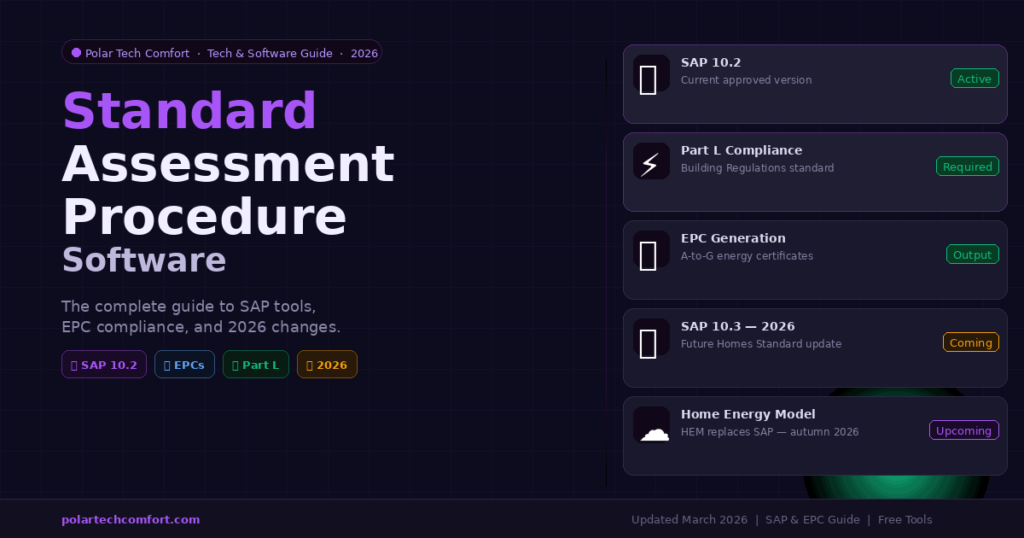
Standard Assessment Procedure (SAP) software automates the UK government’s official methodology for calculating residential energy performance. It produces Energy Performance Certificates (EPCs) and demonstrates compliance with Part L of the Building Regulations. The current approved version is SAP 10.2, with SAP 10.3 expected in 2026 under the Future Homes Standard. Approved tools include Elmhurst Energy, Stroma, and Design SAP.
If you are a property developer, architect, energy assessor, or homeowner trying to understand how your building’s energy rating is calculated, Standard Assessment Procedure software sits right at the centre of that process. It is the digital engine that drives every Energy Performance Certificate issued for residential properties in the UK.
This guide explains what SAP software is, how it works, which tools are approved for use in 2026, what the upcoming changes mean for the industry, and how free online tools can support the process.
What Is Standard Assessment Procedure (SAP)?
The Standard Assessment Procedure is the UK government’s recommended method for measuring the energy rating of residential dwellings. The methodology is owned by the Department for Energy Security and Net Zero, and produced under licence by the Building Research Establishment (BRE).
SAP is used to demonstrate that new dwellings comply with Building Regulations, and for the production of Energy Performance Certificates. In simple terms: SAP is the formula. SAP software is the tool that performs that formula automatically, taking in data about a building and producing a standardised energy rating.
What Is Standard Assessment Procedure Software?
Standard Assessment Procedure software refers to tools designed to calculate energy performance ratings for residential buildings. It applies the official SAP methodology, integrating regulatory formulas, building data, and energy system inputs to produce standardised results.
Without SAP software, the calculations would need to be performed manually using the government’s published worksheet — a complex, multi-step process that would take hours for a single property. SAP software automates this entirely, allowing a qualified assessor to input building data and receive a compliant energy rating and EPC in a fraction of the time.
What Data Does SAP Software Require?
To generate an accurate assessment, SAP software requires detailed input data about the property:
- Building fabric — walls, floors, roofs, windows, and their thermal properties (U-values)
- Heating system type — boiler, heat pump, district heating, and fuel type
- Hot water system — cylinder size, insulation, and heat source
- Ventilation strategy — natural, mechanical, or heat recovery
- Lighting — proportion of low-energy fittings
- Renewable energy systems — solar panels, photovoltaic cells, wind turbines
- Building orientation and geographic location
- Air permeability test results (for new builds)
How SAP Software Works — Step by Step
Approved SAP Software — 2026 Comparison
BRE approves SAP software on behalf of the UK government. Government-approved tools include Elmhurst, Stroma, and Design SAP. Each of these platforms follows the UK’s building rules and uses one standard dataset to ensure accuracy.
| Software | Provider | Best For | SAP Version | EPC Output |
|---|---|---|---|---|
| Elmhurst Energy | Elmhurst | Domestic assessors — most widely used | SAP 10.2 / RdSAP 10 | ✅ Yes |
| Stroma FSAP | Stroma | New build and existing dwellings | SAP 10.2 / RdSAP 10 | ✅ Yes |
| Design SAP | Design SAP Ltd | Architects and developers at design stage | SAP 10.2 | ✅ Yes |
| IES IESVE | IES | Complex builds, professional engineers | SAP 10.2 | ✅ Yes |
| RdSAP Tools | Various | Existing dwellings — simplified entry | RdSAP 10 | ✅ Yes |
SAP vs RdSAP — What Is the Difference?
There are two versions of the Standard Assessment Procedure, each designed for a different situation:
SAP in 2026 — What Is Changing?
The SAP methodology is undergoing its most significant change in decades. Here is what you need to know for 2026:
The Future Homes Standard package remains on track for Q1 2026, so SAP 10.3 will initially be the sole approved methodology. The Home Energy Model (HEM) is expected to follow after at least a 3-month delay. Assessors should prepare for SAP 10.3 compliance requirements from early 2026.
The HEM engine will be delivered via the Energy Calculation as a Service (ECaaS) platform, available by autumn 2026. HEM will eventually replace SAP entirely but both will run simultaneously during a transition period to allow the industry to adapt.
- SAP 10.3 introduces updated emission factors for electricity, reflecting the greener grid
- New fabric efficiency standards under the Future Homes Standard will be more stringent
- HEM will use actual weather data rather than UK averages, making assessments more accurate
- Cloud-based delivery via ECaaS will allow faster updates and API integrations
- All approved SAP software providers will need to update platforms for SAP 10.3 compliance
Who Needs Standard Assessment Procedure Software?
- Energy Assessors — the primary users. Accredited professionals who produce EPCs for residential properties
- Architects and Designers — to model energy performance at design stage and ensure compliance before construction
- Property Developers — to confirm new builds meet Part L requirements and obtain EPCs at completion
- Building Control Bodies — to verify submitted SAP calculations as part of Building Regulations approval
- Local Authorities — to assess planning applications with energy performance requirements
- Homeowners — indirectly, when selling or renting a property that requires a current EPC
Frequently Asked Questions
Standard Assessment Procedure software is used to calculate the energy performance rating of residential buildings in the UK. It automates the official SAP methodology to produce Energy Performance Certificates (EPCs) and demonstrate compliance with Part L of the Building Regulations. It is required for all new residential builds and any property being sold or rented.
Government-approved SAP software tools for 2026 include Elmhurst Energy, Stroma FSAP, Design SAP, and IES IESVE. All approved tools are listed and maintained by BRE (Building Research Establishment) on behalf of the UK government. Assessors must use an approved tool to produce legally valid EPCs.
SAP (full Standard Assessment Procedure) is used for new builds and requires complete building data. RdSAP (Reduced data SAP) is used for existing dwellings — it uses standard assumptions to reduce the amount of data that needs to be collected, making it faster and cheaper to produce. The current versions are SAP 10.2 and RdSAP 10.
Yes — the UK government is developing the Home Energy Model (HEM) to replace SAP. SAP 10.3 remains the sole approved methodology for the Future Homes Standard in Q1 2026, with HEM expected to follow later in 2026. Both will run simultaneously for a transition period to allow the industry to adapt.
Not directly. Homeowners do not need to use SAP software themselves. However, they need an EPC (which is produced using SAP software) when selling or renting their property. The assessment must be carried out by an accredited energy assessor using approved SAP software.
SAP software accounts for renewable energy systems including solar photovoltaic (PV) panels, solar thermal systems, and heat pumps. The energy generated by solar panels is factored into the overall SAP rating, and properties with solar PV can achieve SAP ratings above 100, indicating they are net energy exporters. This directly improves the EPC rating and can significantly reduce calculated energy costs.
Final Thoughts
Standard Assessment Procedure software is the backbone of residential energy compliance in the UK. Whether you are a professional assessor, an architect designing new homes, or a developer managing Building Regulations submissions, understanding how SAP software works — and what is changing in 2026 — is essential. The transition to SAP 10.3 under the Future Homes Standard and the longer-term shift to the Home Energy Model represent the most significant changes to the methodology in decades. Staying informed and ensuring your approved software is updated for compliance will be critical throughout 2026.